
Industrial Boiler Suppliers in Dubai, UAE
For top-of-the-line boilers, we source from Ekotec Turkey, a renowned manufacturer of industrial heating solutions. Their range includes high-efficiency steam and thermal oil boilers, suitable for various industrial applications. These boilers are designed for durability and energy efficiency, offering robust performance in demanding environments.
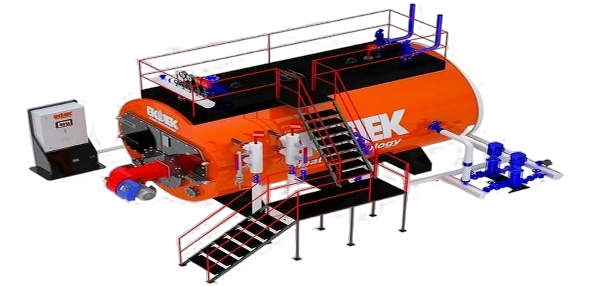
Key Features:
High Thermal Efficiency: Advanced combustion technology ensures efficiency rates of up to 96.48%, reducing fuel
consumption and operating costs.
Versatile Configurations: Available in horizontal and vertical designs, powered by gas, oil, or dual-fuel options to
meet diverse industrial needs.
Premium Quality Materials: Built with high-grade stainless steel and corrosion-resistant components, ensuring
durability and prolonged service life.
Advanced Automation & Control: Equipped with intelligent control systems for easy operation, real-time monitor
ing, and seamless integration with centralized management systems.
Eco-Friendly Design: Low-emission combustion technology minimizes environmental impact while maximizing
performance, with options for condensing technology to recover and utilize excess energy
Applications:
Food & Beverage Industry – Steam supply for cooking, sterilization, and production processes. Textile Manufacturing – Precise steam control for dyeing, drying, and fabric processing. Chemical & Pharmaceutical Industry – Reliable heat source for chemical reactions and process heating. Healthcare & Sterilization – Steam-powered medical equipment sterilization and hospital heating. Power & Energy Sector – Efficient steam generation for power plants and industrial heating systems.
At Climatech, we are committed to delivering high-performance boiler solutions that enhance productivity, reduce energy costs, and promote sustainable operations. Contact us today to discover how our advanced boiler technology can optimize your business.
Types of boiler and what each one is for
Boiler is a broad word covering several quite different machines. Choosing between them starts with what the heat is actually for, not with capacity.
Steam boilers generate steam under pressure for process work. They are the standard where heat has to be moved around a facility and delivered at a controlled temperature: food and beverage production, laundries, textiles, chemical processing, pharmaceutical manufacturing and sterilisation. Steam carries a great deal of energy per kilogram, which is why it remains the default for heavy process duty.
Hot water boilers heat water and circulate it, without generating steam. They suit space heating, domestic hot water at scale, swimming pools and any process that needs heat below boiling point. They run at lower pressure than steam plant, which makes them simpler to operate and generally cheaper to maintain.
Thermal oil boilers heat a thermal fluid rather than water. This matters when a process needs temperatures above what water can practically deliver, because thermal oil reaches high temperatures at low pressure. That combination means high process heat without the pressure vessel requirements and water treatment that steam brings. Common in chemical processing, asphalt, timber and food oil production.
Electric boilers use resistive elements instead of combustion. No flue, no fuel storage, no combustion air, and they can be sited where a fired boiler cannot. Running cost per unit of heat is higher, so they suit lower duties, standby, or sites where a fuel supply or flue is impractical.
Fuel options
Fired boilers run on gas, diesel or heavy oil, or dual fuel burners that switch between them.
Gas is generally the cleanest burning and the simplest to operate where a supply is available. Diesel and oil fired units suit sites without a gas connection, at the cost of fuel storage, handling and more frequent burner maintenance. Dual fuel burners give continuity where gas supply is not guaranteed, and are worth the extra capital wherever an interruption to process heat would stop production.
The fuel decision is usually made by what is available at the site rather than by preference, and it should be settled before capacity is specified, because it affects burner selection, flue design and the plant room layout.
Where boilers are specified in the UAE
Food and beverage production, laundries and commercial laundries, hotels and resorts with significant hot water and spa demand, textile processing, chemical and petrochemical plant, pharmaceutical production, building space heating in larger developments, and swimming pool heating at scale.
The common thread is a process that needs heat delivered reliably and continuously. In most of these settings unplanned downtime costs considerably more than the boiler did, which is why specification and servicing matter more here than the purchase price.
Sizing and specification
Capacity is expressed in kilograms of steam per hour for steam plant, or in kilowatts for hot water and thermal oil systems. Getting the number right depends on the peak demand of the process, how that demand varies through the day, the pressure or temperature the process requires, and whether standby capacity is needed to keep production running during maintenance.
Oversizing is the more common error and it is expensive twice over: higher capital cost, and a boiler that cycles rather than running steadily, which wastes fuel and shortens component life. Undersizing shows up as a plant that cannot meet peak demand, which is usually discovered at the worst possible moment.
Where demand varies widely, two smaller boilers frequently beat one large one. They match load better, and either can be serviced without stopping the process.
Boiler replacement and upgrades
Many boilers running in the UAE are well past the point where replacement pays for itself. Efficiency degrades as heat transfer surfaces scale and foul, burners drift out of adjustment, and insulation deteriorates. A boiler quietly burning more fuel for the same output is a running cost that never appears as a fault.
Replacement is worth assessing when fuel consumption has climbed without a change in production, when breakdowns are becoming routine, when spare parts are getting difficult, or when the process requirement has changed and the plant no longer matches it.
An upgrade does not always mean a new boiler. Burner replacement, improved controls, economisers to recover flue heat, and proper water treatment can each recover a meaningful share of lost efficiency at a fraction of the cost of replacement. It is worth establishing which of those applies before committing to new plant.
Installation and plant room requirements
Fired boilers need combustion air, a correctly sized flue, fuel supply or storage, water treatment, blowdown provision, and safe access for operation and maintenance. Plant rooms also need to satisfy the relevant authority requirements for the emirate the site sits in.
Water treatment deserves particular attention here. UAE water is hard, and untreated feedwater scales heat transfer surfaces quickly. Scale is an insulator, so a scaled boiler burns more fuel to deliver the same heat, and in severe cases causes overheating damage to the pressure parts. Specifying treatment alongside the boiler is not optional in this region.
Servicing and maintenance
Boilers are the one category of plant where maintenance is not discretionary. Beyond efficiency, they are pressure vessels with a burner attached, and they need to be looked after properly.
Routine servicing covers burner inspection and combustion analysis, checking and cleaning heat transfer surfaces, verifying safety valves and controls, testing water level devices, inspecting refractory, and reviewing feedwater treatment and blowdown practice.
Combustion analysis is the item most often skipped and the one that pays for itself fastest. A burner drifting out of correct air to fuel ratio wastes fuel continuously while giving no outward sign that anything is wrong.
Climatech services boiler plant as well as supplying and installing it.
Frequently asked questions
What is the difference between a steam boiler and a hot water boiler?
A steam boiler generates steam under pressure, which carries far more energy and suits process work. A hot water boiler circulates heated water below boiling point, which suits heating and hot water. They are different machines for different jobs, and the process decides which you need.
When would I need a thermal oil boiler instead?
When the process needs temperatures higher than water can practically deliver. Thermal oil reaches high temperatures at low pressure, which avoids the pressure vessel and water treatment requirements that come with high pressure steam.
Should I repair or replace an ageing boiler?
It depends on what has degraded. Burners, controls and insulation are often worth addressing on their own. Pressure parts that have corroded or suffered overheating damage are a different question. We would rather assess the plant than guess.
How often should a boiler be serviced?
At minimum annually, and more frequently on continuous duty plant or where water quality is poor. Combustion should be analysed as part of every service.
Do you supply for both industrial and commercial applications?
Yes. The range covers commercial hot water duties through to industrial steam and thermal oil plant.
Talk to us about your requirement
Call +971 54 574 2443 or email info@climatech.ae with what the heat is for, the capacity or process demand if you know it, the fuel available at the site, and whether this is new plant or a replacement. That is enough for us to advise on type and capacity.
For hot water without a boiler, see heat pump water heaters, solar water heaters and electric hot water storage tanks.
About Company
Since 1995, Climatech has been a pioneer in air treatment solutions including humidification, dehumidification and misting systems, as well as solar and electric water heating and MEP works. Climatech UAE operates from Dubai, serving clients across the Emirates.