
Air Curtains in Dubai, UAE
Air Curtain Suppliers in Dubai, UAE
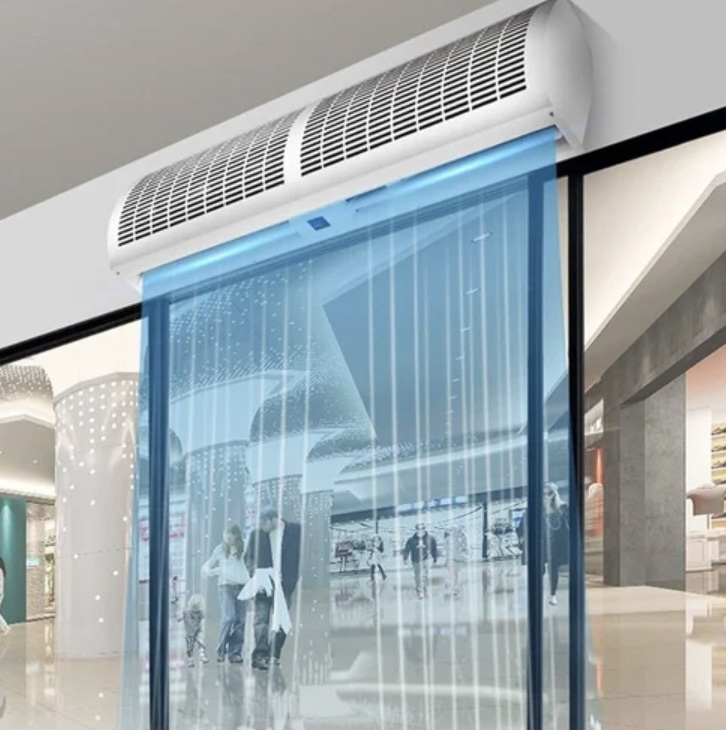
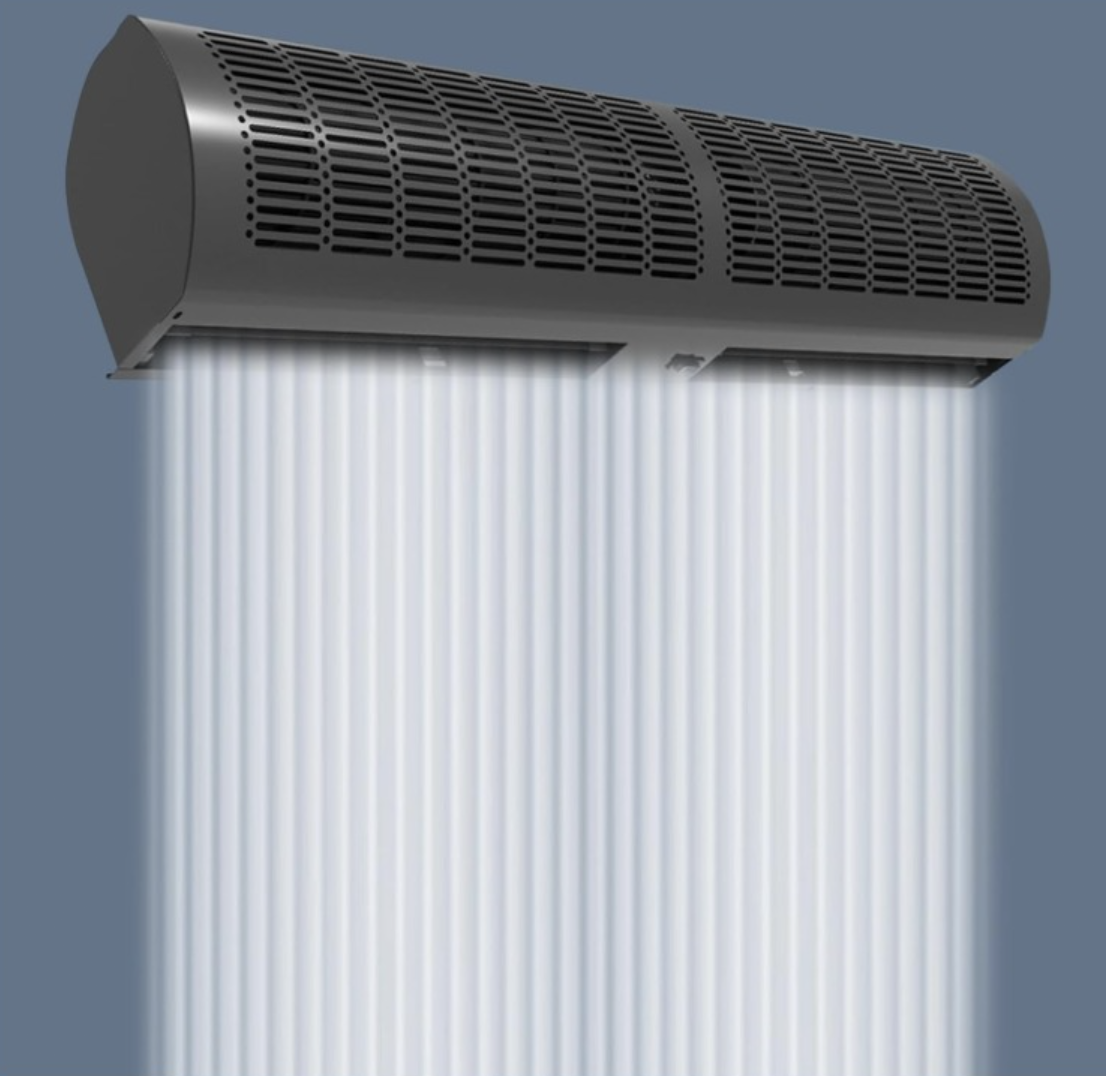
Air curtains are high-performance units installed above entrances to create a powerful invisible air barrier across door openings. They help separate indoor and outdoor environments while allowing smooth and uninterrupted movement of people and goods.
By preventing the escape of conditioned air and reducing the infiltration of hot air, dust, pollutants, and flying insects, air curtains improve indoor comfort and support significant energy savings. They are widely used in commercial, industrial, retail, hospitality, and healthcare facilities where maintaining a controlled indoor environment is essential.
Air curtains are one part of our full product range, which covers dehumidification, humidification, solar water heating and misting.
Key Benefits
- Reduce cooling and heating energy losses
- Improve indoor comfort near entrances
- Minimize dust, pollutants, and insect infiltration
- Maintain clear visibility and smooth traffic flow
- Support HVAC system efficiency and shorter run times
At Climatech, we provide reliable and energy-efficient air curtain solutions designed to enhance comfort, hygiene, and operational efficiency across a wide range of applications.
How an air curtain actually holds the doorway
An air curtain works by projecting a controlled sheet of air across an opening at sufficient velocity and volume to resist the pressure difference trying to push air through it. The stream has to reach the floor with enough energy left to stay coherent, then split, with part of it returning towards the unit and part deflecting outward.
That last detail is what separates a working installation from a decorative one. If the jet loses energy before it reaches the floor, the bottom section of the doorway is effectively open, and warm humid air walks straight in underneath the curtain. The unit is running, using power, and doing very little.
The forces working against it are wind pressure on the facade, the stack effect in tall buildings, and any imbalance between supply and extract ventilation inside. On a high rise entrance or a building with strong mechanical ventilation, those pressures are considerable, and the air curtain has to be specified against them rather than against the door size alone.
Why air curtains underperform
Most disappointing installations trace back to one of the following, and all of them are decided at specification stage.
Insufficient discharge velocity. The single most common fault. An underpowered unit produces a visible airflow that feels like it is working while failing to reach the floor with enough energy to seal.
Unit narrower than the opening. The curtain must cover the full width. Gaps at either side are open doorway, and air will find them.
Mounted too high. Every additional metre between the discharge and the floor costs jet energy. A unit selected for a standard entrance will not perform the same duty mounted above a high shopfront opening.
Wrong discharge angle. Most units allow the nozzle to be angled. On an entrance under outward pressure, aiming slightly outward improves performance significantly. Left square by default, it often will not.
Obstructions. Signage, shutter housings and decorative fascias placed in the discharge path break up the stream.
Mounting configurations
Horizontal, above the door. The standard arrangement and the most effective for most entrances, projecting downward across the opening.
Vertical, at one or both sides. Used where there is no structure above the opening, where the opening is unusually tall, or where the ceiling detail will not accommodate a horizontal unit. Slightly less effective than horizontal for the same duty because the jet works across rather than with gravity.
Recessed into the ceiling. The discreet option for retail and hospitality where the unit should not be visible. It needs to be coordinated with the ceiling design early, because the void depth and the discharge slot position both matter.
Heated, ambient and cooled units
Much of the air curtain literature comes from cold climates, where units are heated to warm incoming air and the entrance lobby. That is the wrong default here.
In the UAE the usual specification is ambient: the unit recirculates conditioned indoor air across the opening without adding heat. The objective is to keep cooled air in and hot humid air out, and adding heat works directly against that.
Cooled air curtains, fed from the chilled water or DX system, are specified where the entrance is particularly exposed or where the lobby needs active conditioning at the threshold. They cost more to install and run, and on the right building they are worth it.
Heated units still have a place in cold rooms and freezer applications, where the duty is different again.
Cold rooms, freezers and food service
On a cold room or freezer door the pressure difference is severe and constant, and the consequence of losing the seal is not just energy. It is frost build up on the evaporator, ice on the floor around the door, condensation on surfaces, and product moving in and out of temperature.
These applications need units specified for the duty rather than a general purpose entrance curtain, and they usually pair with strip curtains or fast acting doors rather than replacing them.
Insect and dust exclusion
For food preparation, retail and hospitality, the hygiene case is often as strong as the energy case. A correctly specified air curtain forms a physical barrier that flying insects cannot easily cross, which supports food safety requirements without a closed door.
Dust matters here too. In a region where airborne dust is constant, an entrance held open all day admits a continuous load of it onto stock, surfaces and into the air conditioning filters. Reducing that ingress reduces cleaning, filter changes and wear.
Controls and integration
A door switch that runs the unit only while the door is open is the simplest and most effective control available, and it is frequently omitted. On an entrance that is genuinely open all day it makes little difference, but on a door that cycles it removes a large amount of unnecessary running.
Two or three speed control lets the unit be set back during quieter periods or milder conditions. Integration with the building management system allows scheduling against opening hours. Where the entrance is in an actively conditioned lobby, interlocking the curtain with the air conditioning avoids the two systems working against each other.
What we need in order to specify correctly
To recommend the right unit we need the clear opening width and height, the mounting height available above the opening, whether the door is open permanently or cycling, what is on the other side of it, and any constraint on how the unit can look or where it can sit.
For cold room and freezer applications we also need the temperature difference across the door and how frequently it is used. For exposed facades it helps to know the orientation and whether the entrance is affected by prevailing wind.
Maintenance
Air curtains move a great deal of air, which means they collect a great deal of dust. Filters and intake grilles need cleaning on a schedule, fans and bearings need periodic checking, and on heated or cooled units the coil needs attention as well.
A clogged intake reduces the volume the unit can move, which reduces jet velocity, which is precisely the failure the unit was installed to avoid. Performance degrades gradually and quietly. Climatech services air curtains as well as supplying and installing them.
Talk to us about your entrance
Call +971 54 574 2443 or email info@climatech.ae with the opening width and height, the mounting space above it, and whether the door stands open or cycles. A photo of the entrance is genuinely useful. That is enough for us to specify the right unit and configuration.
If humid air ingress has already created a moisture problem inside the building, see our dehumidifiers. For cooling semi-open and outdoor areas such as terraces and entrances, see misting systems.
Frequently Asked Questions
What does an air curtain actually do?
How much can an air curtain reduce cooling costs?
What size air curtain do I need for my entrance?
Where are air curtains most commonly installed in the UAE?
Does Climatech install air curtains, or supply only?
About Company
Since 1995, Climatech has been a pioneer in air treatment solutions including humidification, dehumidification and misting systems, as well as solar and electric water heating and MEP works. Climatech UAE operates from Dubai, serving clients across the Emirates.